
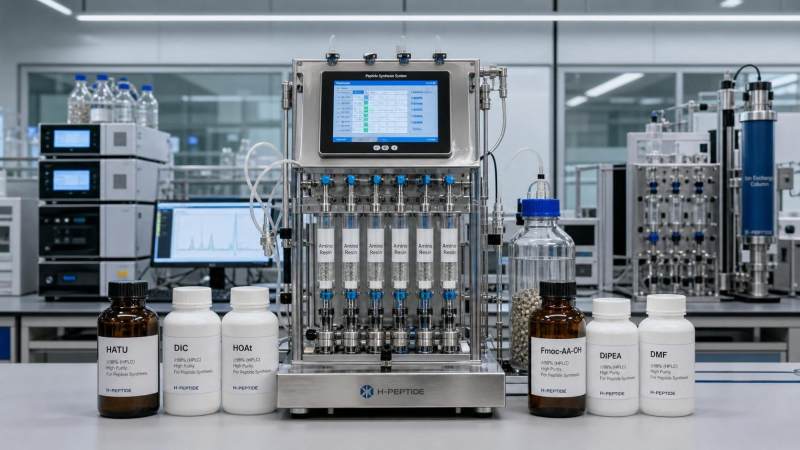
With the growing demand for peptide therapeutics and macromolecular biomaterials, the large-scale manufacturing of long-chain peptides has become a core competency for modern peptide factories. However, as the amino acid chain extends, steric hindrance increases significantly, slowing down the condensation reaction. This often leads to incomplete coupling, truncated peptides, and non-specific side reactions. Achieving high yields while strictly controlling impurities remains a major technical bottleneck in industrial peptide production.
To address these challenges, leading peptide factories systematically deploy three highly coordinated strategies to mitigate steric hindrance and minimize impurities during long-chain peptide synthesis:
1. Intelligent Resin Backbones and Highly Active Coupling Reagents
In Solid-Phase Peptide Synthesis (SPPS), steric hindrance frequently prevents reagents from accessing the active sites on the solid support. To counteract this, peptide factories utilize smart polystyrene or polyethylene glycol (PEG)-based resins featuring low loading capacities and superior swelling properties. This allows the growing long peptide chains to extend freely in the solvent. Furthermore, pairing these supports with next-generation, low-racemization, highly active coupling systems (such as Oxyma/DIC or TATU) drastically improves the coupling efficiency of sterically hindered amino acids, preventing the formation of deletion peptides at the source.
2. Application of Pseudoproline Dipeptide Derivatives
During synthesis, long-chain peptides are prone to forming tight secondary structures (such as β-sheets), which cause peptide aggregation and exacerbate steric hindrance. Advanced peptide factories overcome this by embedding pseudoproline dipeptide derivatives at strategic positions along the sequence. This temporary structural modification disrupts the backbone alignment, effectively preventing peptide aggregation and significantly restoring the reactivity of subsequent amino acids.
3. Precise In-Process Monitoring and Multi-Dimensional Purification
Strict quality control is vital to overcoming impurity challenges. In the synthesis phase, peptide factories employ real-time monitoring tools, such as automated ninhydrin testing or online UV monitoring, to ensure each coupling step reaches completion. For downstream processing, where complex impurities often share extremely similar physicochemical properties with the target product, factories utilize multi-dimensional purification systems—combining Reverse-Phase High-Performance Liquid Chromatography (RP-HPLC) with Ion Exchange Chromatography (IEX)—to secure the stable and reproducible mass production of ultra-high-purity long-chain peptides.
Conclusion
Resolving the steric hindrance and impurity obstacles inherent in long-chain peptides requires a systematic integration of materials science, chemistry, and process engineering. Through continuous technological optimization, modern peptide factories are successfully delivering higher-quality, more cost-effective long-chain peptide customization services to the global biopharmaceutical and research industries.