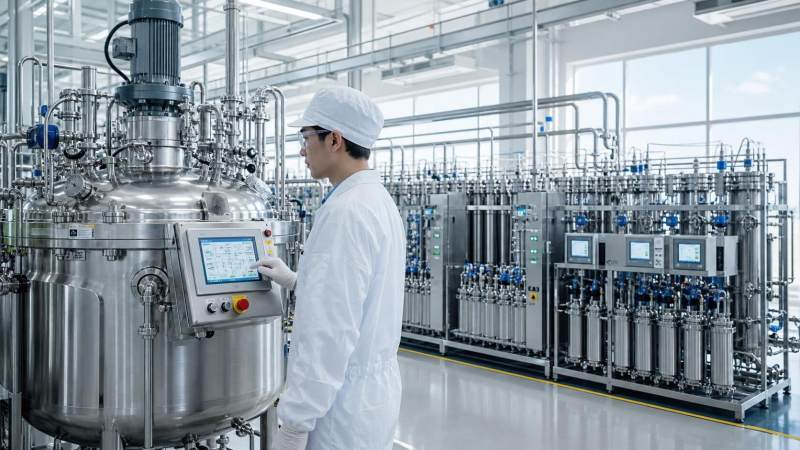
In the development lifecycle of peptide therapeutics, transitioning from milligram-scale laboratory synthesis to ton-scale commercial mass production in a peptide factory is a journey filled with strict technical challenges. Process scale-up is far more than a simple multiplication of volume; it represents a complete re-engineering of reaction kinetics, mass and heat transfer, and process control. To achieve this industrial leap, three core technical gaps must be methodically bridged:
1. Mass/Heat Transfer Limitations and Reaction Uniformity
At the laboratory bench, managing agitation and precise temperature control is relatively straightforward due to the small volumes involved. However, in a ton-scale reactor, the rapid increase in material volume coupled with the massive swelling of solid-phase resins makes the system highly susceptible to localized concentration imbalances and temperature gradients. These mass and heat transfer limitations inevitably lead to a decline in amino acid coupling efficiency, significantly increasing truncated peptides and other structural impurities. To secure reaction uniformity at scale, modern peptide factories typically deploy specialized low-shear agitation systems or advanced continuous flow chemistry.
2. Solvent Consumption Management and Green Environmental Standards
Peptide synthesis heavily relies on large volumes of organic solvents, such as DMF and DCM. During ton-scale mass production, both solvent consumption and wastewater treatment costs escalate exponentially. The scale-up phase must prioritize the optimization of solvent recycling systems, alongside the development of eco-friendly co-solvent systems or aqueous phase synthesis pathways. Maintaining or enhancing crude peptide purity while strictly complying with rigorous global environmental and safety regulations remains a pivotal challenge for industrial manufacturing.
3. Downstream Large-Scale Purification and Preparative Chromatography Load Limits
Purification represents the most cost-intensive segment of peptide manufacturing. As upstream crude peptide outputs surge, downstream Preparative High-Performance Liquid Chromatography (Prep-HPLC) systems face immense capacity pressures. During the scale-up phase, engineers must redesign highly selective stationary phases, optimize elution profiles, and integrate multi-stage crystallization or fluid control technologies. True compliant mass production of peptide drugs can only be achieved once the optimal balance between large capacity, high purity, and economic feasibility is established.
Conclusion
The transition from a laboratory setting to a ton-scale peptide factory demands a systematic, interdisciplinary engineering revolution. Through the continuous optimization of synthesis chemistry, solvent workflows, and advanced purification processes, the modern peptide manufacturing industry is successfully overcoming scale-up bottlenecks, ultimately delivering more cost-effective, high-quality peptide therapeutics to patients worldwide.