
In the manufacturing of peptide therapeutics and high-standard biologics, drug safety and cross-contamination control serve as the primary metrics for evaluating a peptide factory's compliance. Due to the inherent characteristics of peptide molecules—such as their susceptibility to degradation, strong adsorption properties, and potential biological activities—GMP (Good Manufacturing Practice) compliant peptide factories must adhere to exceptionally stringent technical specifications regarding equipment contamination prevention and Clean-in-Place (CIP) validation.
1. Hardware Design Requirements for Equipment Contamination Prevention
To eliminate exogenous contamination and cross-contamination entirely, GMP peptide factories enforce strict regulations on the materials and structural engineering of production equipment:
▪ Material Compliance: All equipment surfaces in direct contact with raw materials and products must be fabricated from high-grade, low-carbon stainless steel (such as 316L) or inert polymers. This ensures robust resistance to acid/alkali corrosion and prevents any leaching of impurities.
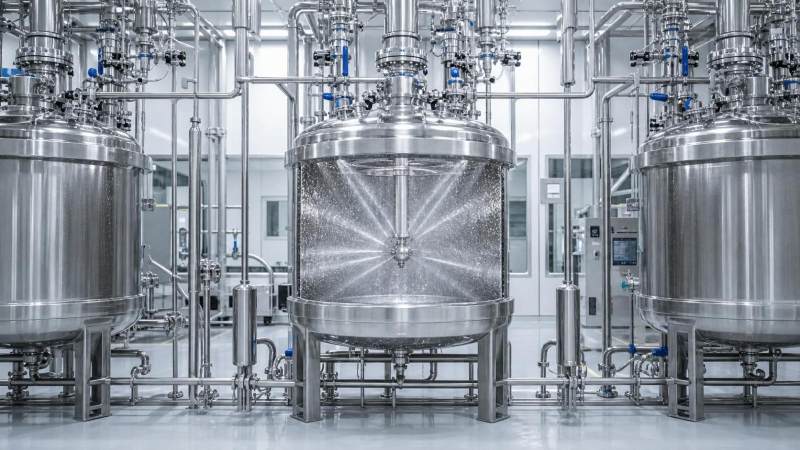
▪ Dead-Leg-Free Design: Reactors, pipelines, and valves must utilize sanitary-grade designs to eradicate dead legs, blind loops, or crevices where product residues could accumulate. Furthermore, orbital welding is widely applied in pipeline connections to minimize the risk of microbial colonization.
2. Rigorous Requirements for Clean-in-Place (CIP) Systems
Peptide synthesis involves various organic solvents, protecting groups, and byproducts with differing viscosities. Relying solely on manual cleaning cannot guarantee consistency; hence, automated CIP systems must meet strict control benchmarks:
▪ Three-Dimensional Spray Coverage: Reaction vessels must be equipped with high-efficiency rotary spray balls to ensure that the cleaning media covers 100% of the interior walls without any blind spots.
▪ Precise Process Parameters: The CIP system digitally monitors and regulates the concentration, temperature, flow rate, and duration of the cleaning agents. A standard cycle typically involves a rigorous multi-step sequence: initial water rinse, acid/alkali wash, purified water rinse, and a final rinse utilizing Water for Injection (WFI).
3. Scientific Standards for Cleaning Validation
Implementing a cleaning process alone is insufficient; GMP standards dictate that a peptide factory must prove its cleaning efficacy through strict empirical validation:
▪ Residue Limit Testing: For peptide manufacturing, highly sensitive trace analytical techniques (such as HPLC or Total Organic Carbon [TOC] analysis) are deployed to verify that residues on equipment surfaces remain well below established safety limits (e.g., 10 ppm or one-thousandth of the minimum daily dose).
▪ Microbial and Endotoxin Control: The conductivity, microbial limits, and bacterial endotoxin levels of the final rinse water must strictly comply with international pharmacopeia standards, preventing pyrogen contamination in subsequent production batches.
Conclusion
Stricter contamination prevention engineering coupled with systematic CIP cleaning validation forms the solid bedrock for a GMP peptide factory to guarantee consistent product quality and absolute regulatory compliance. Through these meticulous industrial engineering practices, modern peptide manufacturing successfully delivers safer, highly reliable raw materials and custom synthesis services to the global biomedical and healthcare sectors.