
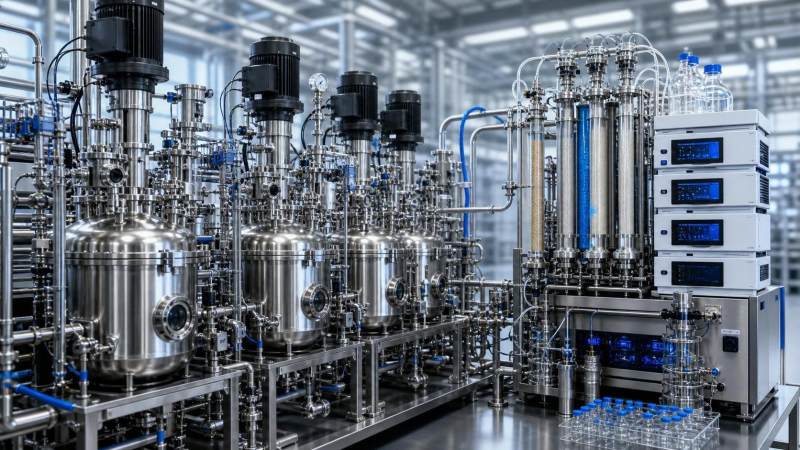
In the field of custom peptide synthesis, long-chain peptides (such as those with amino acid sequences exceeding 50 residues) and highly complex modified peptides (featuring configurations like multiple disulfide-bond cyclizations, phosphorylations, fluorescent labeling, or specialized non-natural amino acids) represent the technical high ground of the industry. The synthesis of these peptides faces two primary adversaries: low synthesis efficiency caused by steric hindrance, and heavy impurity profiles resulting from frequent side reactions. How do professional peptide facilities ensure an ideal final purity while maintaining an acceptable delivery timeline? They typically employ a comprehensive strategy spanning process planning and in-process control.
1. Strategic Route Planning: Merging Fragment Condensation with Solid-Phase Synthesis
When dealing with ultra-long-chain peptides, relying solely on traditional step-by-step solid-phase peptide synthesis (SPPS) causes steric hindrance to increase exponentially as the chain elongates. This leads to a sharp decline in late-stage coupling efficiency and generates large volumes of deletion mutations that are highly difficult to isolate.
◾ Segmented Synthesis Strategy: Experienced peptide facilities implement "fragment condensation" or Native Chemical Ligation (NCL) techniques. Engineers first segment the long chain into several short fragments of 10 to 20 amino acids, allowing them to be synthesized, purified, and verified with high efficiency.
◾ Late-Stage Assembly: Finally, these high-purity fragments are precisely joined together in a liquid-phase environment. This "divide and conquer" strategy not only drastically shortens the total production cycle (boosting synthesis efficiency) but also prevents disastrous purification bottlenecks at the end, ensuring high purity of the final product.
2. Dynamically Optimizing Reaction Systems: Mastering Coupling Reagents and Microwave Assistance
The synthesis efficiency of highly challenging modified peptides is often bottlenecked by the rate of the coupling reaction. To break through this limitation, peptide facilities must perform dynamic micro-adjustments on the reaction environment.
◾ Deploying High-Efficiency Coupling Systems: Advanced coupling reagents with superior adaptability to steric hindrance and exceptionally low racemization rates (such as COMU, PyBOP, etc.) are selected, and reactant ratios are dynamically tweaked based on the specific physical and chemical properties of the sequence.
◾ Thermodynamic Intervention: When synthesizing critical, difficult regions, facilities utilize microwave-assisted peptide synthesis. By applying uniform thermal energy through precise electromagnetic radiation, they accelerate molecular motion and overcome steric hindrance. This cuts coupling times multiple times over without damaging existing modification groups, striking an ideal balance between high conversion rates and low side reactions.
3. Precision Multi-Stage Purification and In-Line Quality Monitoring
Once the preliminary balance between synthesis efficiency and purity is navigated within the reaction vessel, the post-synthesis purification engineering serves as the final arbiter.
Because the crude mixtures of highly complex custom peptides are exceptionally intricate, the target product and its isomeric impurities often share highly similar chemical properties. Instead of a single, conventional purification method, peptide facilities design multi-stage chromatographic purification protocols. For instance, they may perform a crude separation via Reverse-Phase High-Performance Liquid Chromatography (RP-HPLC), followed by fine elution using Ion-Exchange Chromatography (IEX) or Hydrophilic Interaction Liquid Chromatography (HILIC). Concurrently, in-line liquid chromatography-mass spectrometry (LC-MS) fraction tracking ensures each peak cut is executed with absolute precision, exchanging methodical processing space for optimal time-efficiency and high-purity output.
In summary, custom synthesis of long-chain and highly modified peptides is not a mechanical assembly line, but rather a meticulously calculated exercise in molecular engineering. By artistically mapping out synthesis routes, innovating reaction systems, and scaling up purification dimensions, peptide facilities identify the perfect equilibrium between the speed of efficiency and the standard of purity.