
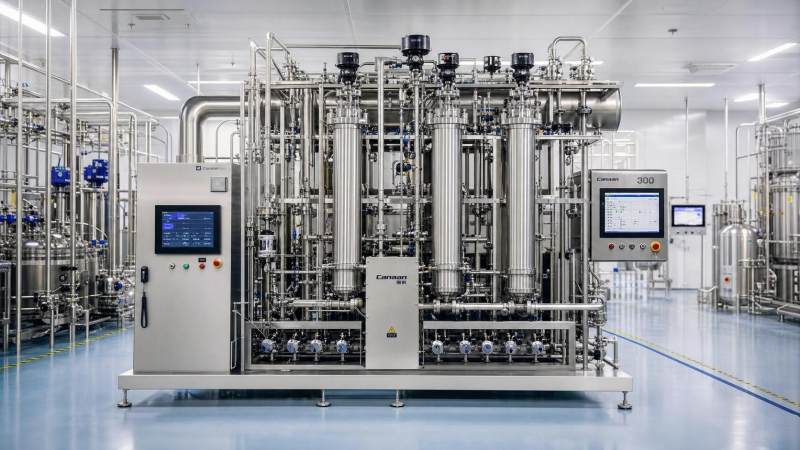
During the procurement process for peptide raw materials, many buyers engaging with a supplier for the first time fall into a common misconception: as long as the bench-scale sample they receive achieves a purity of 98% or higher, they assume the facility possesses excellent manufacturing standards and proceed to confidently place a bulk order. However, in professional supply chain management and B2B supplier auditing, a bench-scale sample's purity is merely a baseline introduction. Evaluating a peptide facility's true, comprehensive capabilities during the commercial mass-production phase cannot be done by looking at sample purity alone.
1. The Massive Technical Chasm Between Laboratory Bench Scale and Industrial Scale-Up
In a peptide facility’s laboratory, R&D personnel synthesizing a few grams or even milligrams of a sample utilize meticulous micro-operations, premium laboratory-grade reagents, and work without the constraints of time costs.
◾ The Challenge of the Scale-Up Effect: When the manufacturing scale is magnified from "grams" to "kilograms" or even "tons," the mass transfer and heat transfer efficiencies within the reaction vessels undergo qualitative changes.
◾ The Difficulty of Side-Reaction Control: In a raw material charge that has been magnified hundreds or thousands of times, localized temperature variances or uneven stirring can easily trigger severe side reactions, causing impurities to skyrocket. A facility capable of delivering an excellent sample may still suffer from plummeting yields or severe batch-to-batch inconsistencies during bulk manufacturing if it lacks mature scale-up engineering experience.
2. Significant Discrepancies in the Capacity of Purification Processes
Achieving high-purity peptides relies heavily on post-synthesis chromatographic purification. During the bench-scale phase, a facility can use high-resolution, small-scale chromatography columns to slowly elute and precisely cut peak fractions, thereby obtaining an ultra-pure sample.
However, during commercial large-scale production, the facility must deploy industrial-grade Preparative High-Performance Liquid Chromatography (Prep-HPLC) systems. This tests the facility's industrial purification capacity to its limits. Bulk manufacturing requires a delicate balance between "purity, yield, and production cycle time." If a facility’s industrial purification methodology is immature, pursuing a single purity metric can lead to an unsustainably high material loss rate during bulk runs, translating directly into commercial risks such as severe delivery delays or mid-contract price increases.
3. Samples Fail to Reflect Overall Regulatory Compliance and Batch-to-Batch Stability
A sample’s Certificate of Analysis (COA) provides a single point of static data, whereas bulk manufacturing tests a facility’s dynamic enforcement of its overall Standard Operating Procedures (SOPs).
True industrial competence is demonstrated when the physical and chemical properties, impurity profiles, salt-form ratios, and microbial metrics remain highly consistent and stable across 5, 10, or more consecutive bulk batches. This long-term batch-to-batch stability relies heavily on the cleanroom environmental controls of the facility, the stability of its raw material supply chain, precision maintenance of production equipment, and the rigorous auditing of its Quality Control (QC) team. These hidden "hard capabilities" can never be fully reflected in a single, flawless sample.
Consequently, to evaluate the true capabilities of a peptide facility, buyers should look beyond sample purity and further investigate its scale-up track record, maximum single-batch capacity, regulatory quality management credentials, and the traceability of its raw analytical charts. Only a multi-dimensional comprehensive evaluation can guarantee the safety and stability of a bulk mass-production supply chain.